
Esta es una de las preguntas más comunes que hacen las familias.
“¿Podemos recuperar nuestro dinero del fiador?”
La respuesta depende de qué dinero estés hablando.
Eso puede sonar molesto.
Es molesto.
Pero importa.
Porque “dinero de bonos” puede significar más de una cosa.
Puede significar premium.
Puede referirse a una garantía.
Puede significar dinero pagado a la corte.
Esos no son lo mismo.
Si los mezclas, puedes pensar que el dinero debería regresar cuando quizás no lo haga.
Así que vamos a simplificarlo.
¿Qué es la prima de una fianza?
Una prima es la tarifa que se paga a la compañía de fianzas.
La empresa de fianzas presenta la fianza de garantía.
Esa fianza ayuda a que la persona sea liberada de custodia.
La prima es el costo de ese servicio.
Piensa en ello como si pagaras por un trabajo que hay que hacer.
Una vez que el trabajo está hecho, la tarifa a menudo se gana.
En un caso de fianza, una vez que se presenta la fianza y se libera a la persona, la prima suele considerarse devengada según la documentación de la fianza.
Por eso las familias necesitan preguntar sobre los reembolsos antes de firmar.
No después.
Después es cuando todos se ponen ruidosos.
¿Es Premium lo mismo que fianza en efectivo?
No.
La prima se paga a la compañía de fianzas.
La fianza en efectivo se paga a la corte.
Esos son diferentes.
Si paga en efectivo al tribunal, ese dinero puede ser manejado por el tribunal.
Si pagas un prima a una empresa de fianzas, ese dinero paga el servicio de la deuda.
Aquí es donde las familias se confunden.
Oyen a alguien decir: “Deberías recuperar el dinero de la fianza”.”
¿Pero de qué dinero están hablando?
¿Dinero del tribunal?
¿Colateral?
¿Premium?
Necesitas saber.
¿Qué es una garantía?
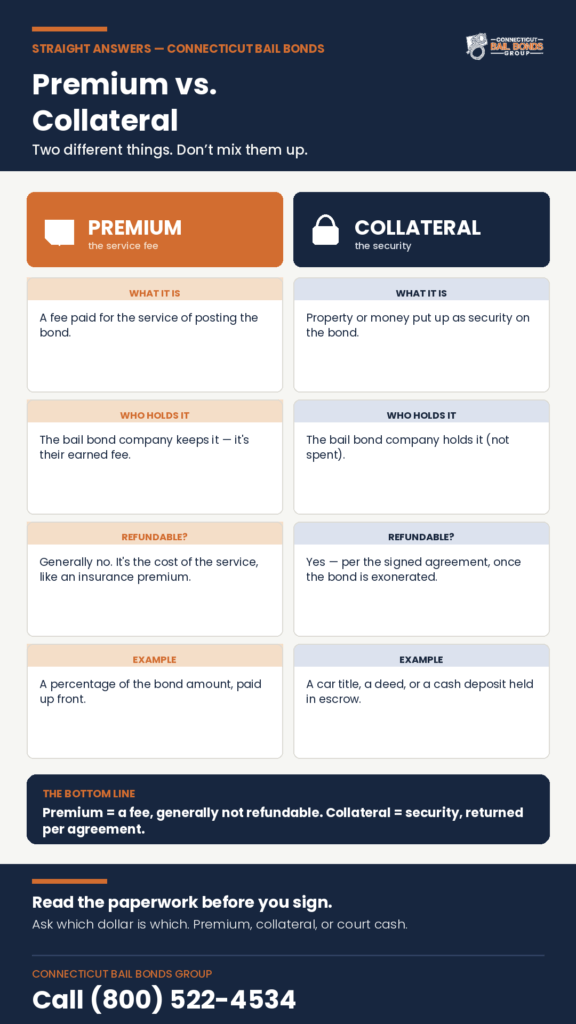
La garantía es algo que se utiliza para proteger a la empresa de fianzas en caso de que surja algún problema.
Puede que sea dinero.
Podría ser propiedad.
Podría ser otra cosa de valor.
Colateral no es lo mismo que prima.
La prima es la tarifa.
La garantía es un aval.
Si el demandado cumple con lo que debe hacer, la garantía podrá devolverse según lo estipulado en el acuerdo.
Si el acusado no se presenta ante el tribunal o incumple los términos de la fianza, la garantía podría estar en riesgo.
De nuevo, lee los papeles.
No adivines.
Adivinar con el papeleo de la fianza es como jugar a los dardos en la oscuridad.
Tal vez golpeaste el tablero.
Quizás chocaste contra la pared de alguien.
Por qué las familias creen que se debe reembolsar la prima
Muchas familias piensan así:
“Pagamos al fiador.”
“La persona salió.”
“Entonces el juez cambió la fianza.”
“Así que deberíamos recuperar nuestro dinero.”
Eso suena justo en sus mentes.
Pero tal vez no coincida con cómo funciona el bono.
Si la compañía fiadora pagó la fianza de caución y la persona fue liberada, la compañía proporcionó el servicio.
Una decisión judicial posterior no siempre anula eso.
La corte puede añadir una nueva condición.
El fiscal podría pedir una fianza mayor.
El juez puede aumentar la fianza.
Pero eso no significa automáticamente que la prima original sea devuelta.
Por eso los trámites son importantes.
¿Qué pasa si el abogado dice que recuperemos el dinero?
¿A qué dinero se refiere el abogado?.
El El abogado podría estar hablando del dinero en efectivo pagado al tribunal.
El abogado podría estar hablando de bienes colaterales.
El abogado podría estar hablando de un pago que no se utilizó.
O el abogado no haya visto la documentación del bono de fianza.
No asumas.
Pregúntale al abogado esto:
“¿Te refieres a la prima, la garantía o el efectivo pagado al tribunal?”
Esa única pregunta puede evitar mucha confusión.
También puede detener una pelea familiar.
Y esas nunca son divertidas.
Especialmente cuando todos ya están estresados.
¿Qué debes preguntar antes de pagar a una compañía de fianzas?
Haz estas preguntas antes de pagar:
¿Cuál es la prima?
¿Es reembolsable la suscripción premium?
¿Se requiere garantía?
¿Qué pasa con la garantía?
¿Qué pasa si el juez cambia la fianza más tarde?
¿Qué pasa si el acusado no se presenta en la corte?
¿Qué sucede si el caso es desestimado?
¿Qué sucede si el acusado es devuelto a prisión?
¿Me puede dar un recibo?
¿Puedo obtener copias de todo lo que firmo?
Estas preguntas son sencillas.
Pero las preguntas sencillas ahorran dinero.
¿Qué trámites debes conservar?
Mantener todo.
Conserva el acuerdo de fianza.
Guarda los recibos.
Guarda los registros de pago.
Guardar mensajes de texto.
Mantener correos electrónicos.
Mantener los documentos colaterales.
Conserva los documentos judiciales.
Si hay una disputa más adelante, el papeleo es importante.
No es lo que alguien recuerda.
No es lo que alguien pensó haber oído.
No es lo que dijo el primo de alguien en la cena.
Trámites.
Siempre conserva los papeles.
Por qué esto importa en casos de bonos grandes
Mientras mayor sea el vínculo, más cuidado deberá tener la familia.
Un pequeño error en un pequeño bono puede ser frustrante.
Un error en un bono grande puede ser un desastre financiero.
Cuando los bonos son grandes, puede haber más personas involucradas.
Padres.
Cónyuges.
Hermanos.
Amigos.
Abogados.
Agentes de fianzas.
Cada persona puede escuchar algo diferente.
Es por eso que la documentación clara y las preguntas claras son importantes.
No te apresures tanto que no entiendas lo que estás pagando.
Rápido es bueno.
Ciego no es.
El punto principal
Una fianza de fianza suele ser la tarifa que se paga por el servicio de la compañía de fianzas.
No es lo mismo que efectivo pagado a la corte.
No es lo mismo que una garantía.
Si la fianza se depositó y la persona fue liberada, la prima podría no ser reembolsable.
Pero cada familia debe revisarP the papeleta firmada y hacer preguntas directas.
No uses la palabra “dinero de fianza” sin preguntar de qué tipo de dinero se trata.
Esa frase causa la mitad de los problemas.
Quizás más.
Pensamientos finales
Antes de pagarle a una compañía de fianzas, entiende qué estás pagando.
¿Qué es premium?.
¿Qué es una garantía?.
¿Qué va a la corte?.
¿Qué se puede devolver?.
¿Qué no se devolverá?.
Si alguien no puede explicarlo en un inglés sencillo, sigue preguntando.
Este es tu dinero.
Tienes derecho a entender a dónde va esto.
Descargo de responsabilidad: Esta página es solo para información general. No constituye asesoramiento legal. Los derechos y deberes de reembolso pueden depender de la documentación firmada, las órdenes judiciales y la ley de Connecticut. Hable con un abogado de Connecticut si tiene una pregunta legal.
Antes de depositar una fianza en Connecticut, llame a nuestra oficina. Podemos explicarle la prima, la garantía, el papeleo y los plazos de pago antes de que firme.
