
This is one of the most common questions families ask.
“Can we get our money back from the bail bondsman?”
The answer depends on what money you are talking about.
That may sound annoying.
It is annoying.
But it matters.
Because “bond money” can mean more than one thing.
It can mean premium.
It can mean collateral.
It can mean cash paid to the court.
Those are not the same.
If you mix them up, you may think money should come back when it may not.
So let’s make it simple.
What Is a Bail Bond Premium?
A premium is the fee paid to the bail bond company.
The bail bond company posts the surety bond.
That bond helps get the person released from custody.
The premium is the cost of that service.
Think of it like paying for work to be done.
Once the work is done, the fee is often earned.
In a bail case, once the surety bond is posted and the person is released, the premium is usually treated as earned under the bond paperwork.
That is why families need to ask about refunds before signing.
Not after.
After is when everyone gets loud.
Is Premium the Same as Cash Bail?
No.
Premium is paid to the bail bond company.
Cash bail is paid to the court.
Those are different.
If you pay cash to the court, that money may be handled by the court.
If you pay a premium to a bail bond company, that money pays for the bond service.
This is where families get confused.
They hear someone say, “You should get the bond money back.”
But what money are they talking about?
Court cash?
Collateral?
Premium?
You need to know.
What Is Collateral?
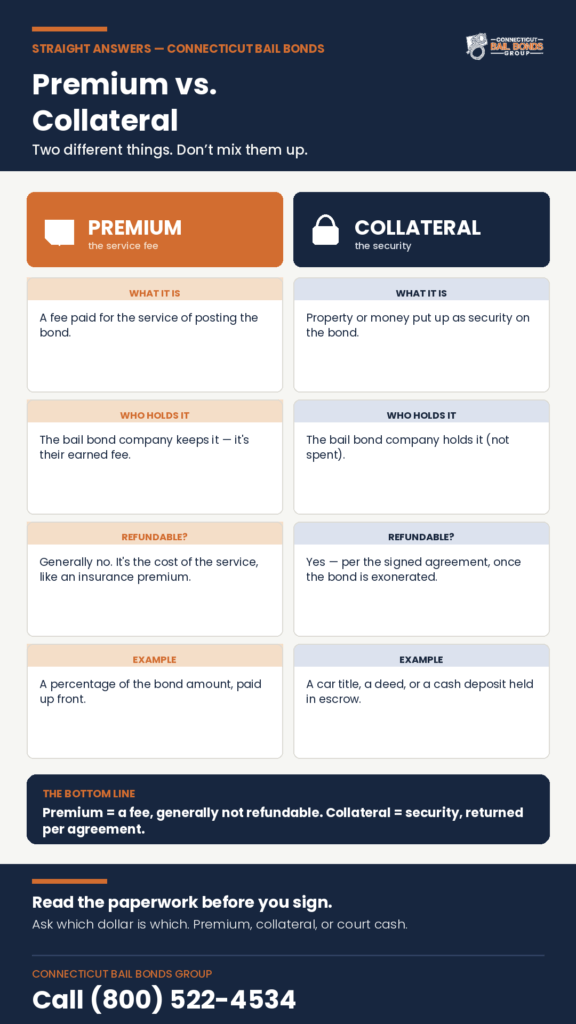
Collateral is something used to protect the bail bond company if there is a problem.
It may be money.
It may be property.
It may be something else of value.
Collateral is not the same as premium.
Premium is the fee.
Collateral is security.
If the defendant does what they are supposed to do, collateral may be returned based on the agreement.
If the defendant misses court or breaks the bond terms, collateral may be at risk.
Again, read the paperwork.
Do not guess.
Guessing with bail paperwork is like playing darts in the dark.
Maybe you hit the board.
Maybe you hit someone’s wall.
Why Families Think the Premium Should Be Refunded
Many families think this way:
“We paid the bail bondsman.”
“The person got out.”
“Then the judge changed the bond.”
“So we should get our money back.”
That sounds fair in their head.
But it may not match how the bond works.
If the bail bond company posted the surety bond and the person was released, the company provided the service.
A later court decision does not always undo that.
The court may add a new condition.
The prosecutor may ask for more bond.
The judge may increase the bond.
But that does not automatically mean the original premium is returned.
That is why the paperwork matters.
What if the Attorney Says to Get the Money Back?
Ask what money the attorney means.
The attorney may be talking about cash paid to court.
The attorney may be talking about collateral.
The attorney may be talking about a payment that was not used.
Or the attorney may not have seen the bail bond paperwork.
Do not assume.
Ask the attorney this:
“Are you talking about the premium, the collateral, or cash paid to the court?”
That one question can stop a lot of confusion.
It can also stop a family fight.
And those are never fun.
Especially when everyone is already stressed.
What Should You Ask Before Paying a Bail Bond Company?
Ask these questions before you pay:
What is the premium?
Is the premium refundable?
Is collateral required?
What happens to collateral?
What happens if the judge changes the bond later?
What happens if the defendant misses court?
What happens if the case is dismissed?
What happens if the defendant is taken back into custody?
Can I get a receipt?
Can I get copies of everything I sign?
These questions are simple.
But simple questions save money.
What Paperwork Should You Keep?
Keep everything.
Keep the bail bond agreement.
Keep receipts.
Keep payment records.
Keep text messages.
Keep emails.
Keep collateral documents.
Keep court papers.
If there is a dispute later, paperwork matters.
Not what someone remembers.
Not what someone thought they heard.
Not what someone’s cousin said at dinner.
Paperwork.
Always keep the paperwork.
Why This Matters in Large Bond Cases
The larger the bond, the more careful the family needs to be.
A small mistake on a small bond can be frustrating.
A mistake on a large bond can be a financial mess.
When bonds are large, there may be more people involved.
Parents.
Spouses.
Siblings.
Friends.
Attorneys.
Bail agents.
Everyone may hear something different.
That is why clear paperwork and clear questions matter.
Do not rush so fast that you do not understand what you are paying.
Fast is good.
Blind is not.
The Main Point
A bail bond premium is usually the fee paid for the bail bond company’s service.
It is not the same as cash paid to the court.
It is not the same as collateral.
If the bond was posted and the person was released, the premium may not be refundable.
But every family should review the signed paperwork and ask direct questions.
Do not use the word “bond money” without asking what kind of money it is.
That phrase causes half the problems.
Maybe more.
Final Thoughts
Before paying a bail bond company, understand what you are paying.
Ask what is premium.
Ask what is collateral.
Ask what goes to the court.
Ask what may be returned.
Ask what will not be returned.
If someone cannot explain it in plain English, keep asking.
This is your money.
You have the right to understand where it is going.
Disclaimer: This page is for general information only. It is not legal advice. Refund rights and duties may depend on the signed paperwork, court orders, and Connecticut law. Speak with a Connecticut attorney if you have a legal question.
Before you post a bond in Connecticut, call our office. We can explain the premium, collateral, paperwork, and payment terms before you sign.
