
Yes, a bond can be changed after someone has already been released.
That answer surprises a lot of families.
They think once the bond is posted, the bond is done.
That is not always true.
In some cases, the prosecutor may ask the judge to increase the bond.
The prosecutor may also ask for stricter release terms.
The judge may agree.
The judge may not.
But the issue can come back up.
That is why families need to be ready.
Why Would Bond Be Increased?
Bond may be increased when the prosecutor believes the current bond is not enough.
That can happen for many reasons.
The charge may be serious.
The case may involve a firearm.
The case may involve drugs.
The person may have a prior record.
The person may have missed court before.
The prosecutor may say the person is a safety risk.
The prosecutor may say the person may not come back to court.
That does not mean the prosecutor is always right.
It means the prosecutor may ask.
Then the defense attorney can respond.
Then the judge decides.
Does the Bail Bondsman Decide This?
No.
The bail bondsman does not decide if a bond goes up.
The bail bondsman does not decide if a 30 percent cash bond is added.
The court decides.
This is one of the biggest points families need to understand.
The bail bond company handles the bond.
The attorney handles the court argument.
The judge makes the order.
Those are different roles.
If you blame the bondsman for something the judge ordered, you may be yelling at the wrong person.
And yelling at the wrong person rarely solves anything.
It just raises blood pressure.
What Happens at the Next Court Date?
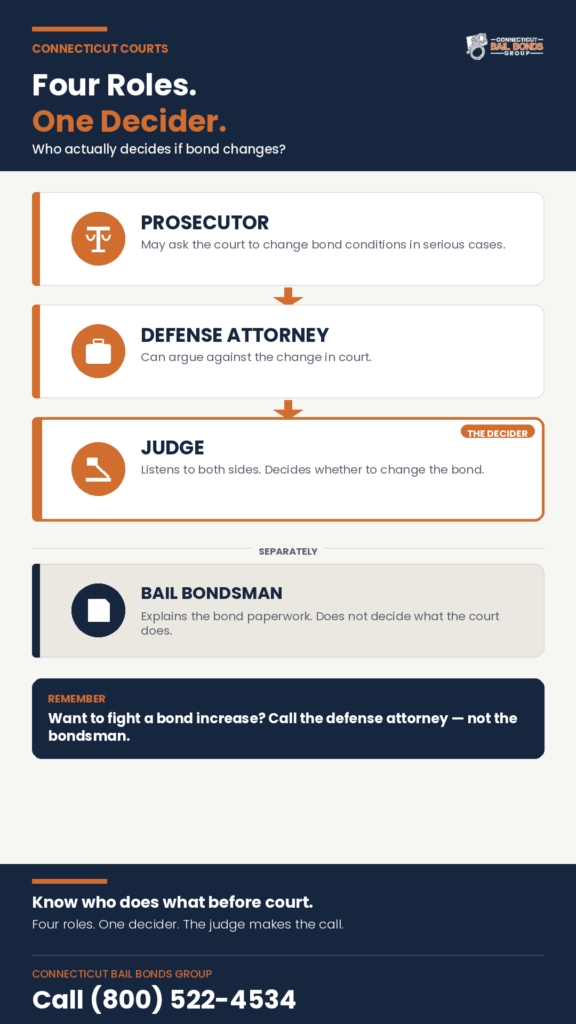
At a court date, the prosecutor may ask the judge to review the bond.
The defense attorney may argue that the bond should stay the same.
The attorney may bring up facts that help the defendant.
That may include family ties.
Work history.
Lack of missed court dates.
Health issues.
Lack of prior record.
Or other facts that matter.
The judge listens.
Then the judge decides.
In a serious case, this hearing can be very important.
Families should not treat it like a simple check-in.
It may not be simple at all.
Can the Judge Add a 30 Percent Cash Requirement?
In certain cases, yes.
A judge may add a cash requirement if the law allows it and the judge agrees.
This is often talked about in serious firearm cases.
But not every case with a gun is the same.
The exact charge matters.
That is why the defense attorney should review the law and the charges.
The family should not guess.
Guessing is not a plan.
It is just panic wearing shoes.
What Happens to the Original Bond?
The original surety bond may still matter.
If the bail bond company posted the bond and the person was released, the company did the job it was hired to do.
The premium paid to the bail bond company is not the same as cash paid to the court.
If the court later adds a new condition, that does not always mean the first bond premium gets refunded.
Families need to review the paperwork.
They should ask the bail bond company what was paid.
They should ask what was premium.
They should ask what was collateral.
They should ask what, if anything, may be returned.
Do not assume.
Read the papers.
Ask the questions.
Can the Defense Attorney Fight the Bond Increase?
Yes, the defense attorney can argue against the increase.
That does not mean the attorney will win.
But the argument matters.
The attorney may argue the original bond is enough.
The attorney may argue the new request is too high.
The attorney may argue the defendant is not a flight risk.
The attorney may argue the law does not allow the 30 percent cash request in that case.
The attorney may ask the judge for other terms instead.
Again, the judge decides.
But the attorney is the person who makes the legal argument.
Not the bail bondsman.
Not the family.
Not the loud uncle who has watched every crime show on TV.
The attorney.
What Should Families Do Before Court?
Families should talk to the defense attorney before the hearing.
Ask if the prosecutor may request a bond change.
Ask if the case could involve a cash bond issue.
Ask what facts may help.
Ask what documents the attorney may need.
Ask what the family should expect.
Also talk to the bail bond company.
Ask what happens if the bond is increased.
Ask what happens if the person is taken back into custody.
Ask what your paperwork says.
Ask what your financial risk is.
These are not small questions.
Do not wait until after court to ask them.
Why This Is So Frustrating
Families feel blindsided when bond changes after release.
That makes sense.
They paid money.
They got the person out.
They thought the crisis was over.
Then the court says, “Not so fast.”
That is frustrating.
But it can happen.
The best defense against confusion is clear information before the next court date.
You may not control what the judge does.
But you can control how prepared you are.
That matters.
The Main Point
A Connecticut judge can change bond conditions after someone has already been released.
The prosecutor can ask.
The defense attorney can argue.
The judge decides.
If the case is serious, families should prepare before the next court date.
Do not assume the first bond will be the last word.
In some cases, it may not be.
Final Thoughts
Posting bond is a big step.
But it may not be the final step.
If your loved one has a serious criminal case, especially one involving guns, drugs, or a high bond, talk with the attorney and the bail bond company before the next court date.
Know what could happen.
Know what was paid.
Know what you signed.
Know what questions to ask.
Because when bond goes up, panic goes up too.
And panic is terrible at math.
Disclaimer: This page is for general information only. It is not legal advice. Speak with a Connecticut criminal defense attorney about your case.
If you posted a large bond and are worried the prosecutor may ask for more, call our office. We can explain the bond side and help you know what questions to ask your attorney.
