
A 30 percent cash bond can scare a family fast.
And it should.
Because it can mean a lot of money.
Most families hear “bond” and think one thing.
But bond can mean different things.
There is surety bond.
There is cash bond.
There is bond premium.
There is collateral.
And yes, because life is not confusing enough, people often call all of it “bond.”
Great system, right?
Let’s make it simple.
What Is a 30 Percent Cash Bond?
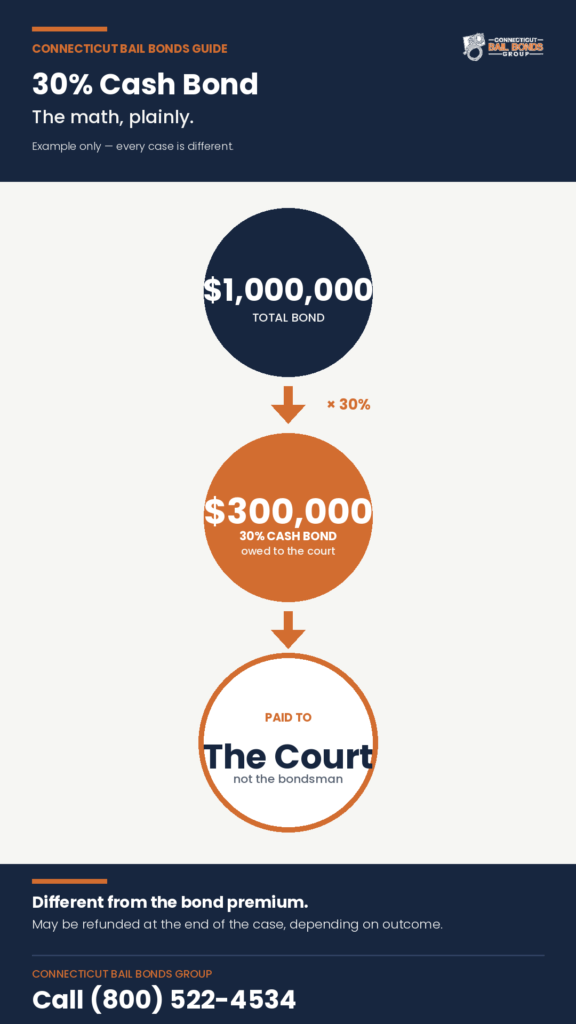
A 30 percent cash bond means the court wants part of the bond paid in cash.
That money goes to the court.
It does not go to the bail bond company.
Here is an example.
If the court sets bond at $500,000 and orders 30 percent cash, the cash amount would be $150,000.
If the court sets bond at $1,000,000 and orders 30 percent cash, the cash amount would be $300,000.
That is real money.
That is house money.
That is “everyone in the family starts checking bank accounts” money.
Is 30 Percent Cash the Same as a Bail Bond Premium?
No.
This is where many families get confused.
A bail bond premium is the fee paid to the bail bond company.
The bail bond company posts the surety bond.
That helps get the person released from custody.
A 30 percent cash bond is different.
That money is paid to the court.
The bail bond company does not control that cash amount.
The judge does.
So when someone says, “We already paid the bond,” we need to know what they mean.
Did they pay a premium to a bail bond company?
Did they pay cash to the court?
Did they give collateral?
Those are not the same thing.
Why Would a Judge Order 30 Percent Cash?
A judge may order a 30 percent cash bond in certain serious cases.
This can come up in some firearm cases.
It may also come up when the court has concerns about safety or whether the person will come back to court.
The prosecutor may ask for it.
The defense attorney may argue against it.
Then the judge decides.
This is why serious cases need serious attention.
A large bond is not just a money problem.
It is also a court problem.
Does Every Gun Case Get a 30 Percent Cash Bond?
No.
Do not assume that.
Not every case with a gun is treated the same way.
The exact charge matters.
The law matters.
The facts matter.
The person’s record may matter.
This is why the defense attorney needs to look closely at the case.
A bail bondsman can explain the bond process.
But the attorney is the one who argues the legal issue in court.
That part is important.
Can a 30 Percent Cash Bond Be Added Later?
In some cases, bond conditions may be changed after release.
That means a person may be out of jail on a surety bond, then later the prosecutor asks the judge for a change.
The judge may say yes.
The judge may say no.
The judge may change part of the bond.
Families need to know this can happen.
Posting bond does not always mean the bond issue is done forever.
In serious cases, the next court date can matter a lot.
What Happens if the Family Cannot Pay the 30 Percent Cash?
If the family cannot pay, the person may not be able to stay out or get out under those terms.
The defense attorney may ask the court to review or change the bond.
But there is no promise the judge will agree.
Do not let anyone promise you a court result.
That is not real life.
That is sales talk.
And sales talk in a criminal case can get expensive.
What Should Families Ask?
Before posting a large bond, ask simple questions.
What is the full bond amount?
Is there a cash requirement?
How much must be paid to the court?
How much is paid to the bail bond company?
Is the money a premium?
Is any money collateral?
What happens at the next court date?
Can the prosecutor ask for more bond later?
What does the attorney think may happen?
These questions matter.
They can save you from a lot of shock later.
Why This Matters
Most families are not ready for a 30 percent cash bond.
They may have already paid a premium to the bail bond company.
Then they hear the judge wants cash too.
Now they feel like they paid once and are being asked to pay again.
That feeling is normal.
But the money may be for different things.
Premium is one thing.
Court cash is another thing.
Collateral is another thing.
When people mix those up, everyone gets mad.
And nobody gets smarter.
The Main Point
A 30 percent cash bond means the court wants part of the bond paid in cash.
It is not the same as a bail bond premium.
It is not the same as collateral.
It is a court order.
If this comes up in your case, speak with the defense attorney right away.
Also speak with the bail bond company so you understand what was already paid and what it was for.
Final Thoughts
A 30 percent cash bond is a big deal.
Do not guess your way through it.
Ask questions.
Get clear answers.
Understand who gets paid.
Understand what the payment is for.
And never assume that all “bond money” is the same.
That one mistake can cause a whole lot of yelling around the kitchen table.
Nobody needs that.
Disclaimer: This page is for general information only. It is not legal advice. Talk to a Connecticut criminal defense attorney about your specific case.
If your loved one has a serious case in Connecticut and you are trying to understand a 30 percent cash bond, call our office before you make a large payment.
