

This question comes up more than people think.
A family pays a bail bond company.
The person gets released.
Then something changes in court.
The attorney says, “You should get your money back.”
Now the family is upset.
They call the bondsman.
The bondsman says the premium is not refundable.
Now everyone is mad.
And confused.
And probably texting in all caps.
So what happened?
Most of the time, the problem is one word.
Bond.
Everyone is using the same word, but they may not mean the same thing.
The Word “Bond” Causes Problems
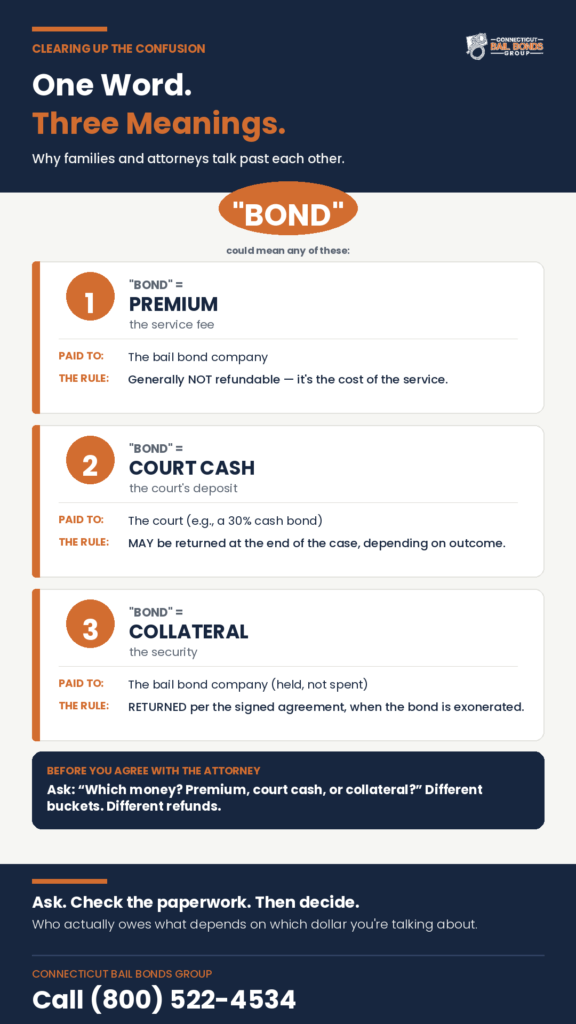
People use “bond” to mean many things.
A family may say bond and mean the money paid to the bondsman.
An attorney may say bond and mean the court bond amount.
A judge may say bond and mean the release condition.
A bondsman may say bond and mean the surety bond that was posted.
A co-signer may say bond and mean collateral.
See the problem?
Same word.
Different meanings.
That is how a simple sentence turns into a mess.
When someone says, “Get the bond money back,” ask what money they mean.
Do they mean premium?
Do they mean collateral?
Do they mean cash paid to court?
Do they mean unused money?
That question matters.
Premium Is Not the Same as Collateral
The premium is the fee paid to the bail bond company.
Collateral is security for the bond.
Those are not the same.
The premium pays for the service.
Collateral protects the bail bond company if something goes wrong.
If the defendant misses court, collateral may be at risk.
If the case ends and all terms are met, collateral may be returned based on the agreement.
But the premium may not be handled the same way.
This is why the paperwork matters.
Not feelings.
Not guesses.
Paperwork.
Premium Is Not the Same as Court Cash
Court cash is money paid to the court.
A bail bond premium is paid to the bail bond company.
If an attorney says money should come back, they may be talking about court cash.
Or they may be talking about collateral.
Or they may not know exactly what was paid.
That does not mean the attorney is bad.
It means everyone needs to slow down and define the money.
What was paid?
Who was it paid to?
What was it for?
Was it premium?
Was it collateral?
Was it cash paid to court?
Was it a payment plan?
Was it a deposit?
These questions clear up the mess.
Why the Attorney May Say This
The attorney may be focused on the court side of the case.
That is the attorney’s job.
The attorney may see that the court changed the bond.
The attorney may think some money should be returned.
But the attorney may not have the bail bond contract in front of them.
The attorney may not know what was premium and what was collateral.
That is why families should not jump straight to blame.
Ask for clarity first.
It is cheaper.
And it usually works better than yelling.
Yelling feels good for about eight seconds.
Then you still have the same problem.
What Should the Family Do?
First, gather the paperwork.
Get the bail bond agreement.
Get the receipt.
Get any collateral forms.
Get payment records.
Get any court orders about the bond.
Then ask clear questions.
Ask the attorney:
“When you said we should get our money back, what money did you mean?”
Ask the bondsman:
“What part of this payment was premium?”
“What part was collateral?”
“Was any money paid to the court?”
“What does the agreement say about refunds?”
These questions help everyone speak the same language.
That is the goal.
Do Not Assume the Bondsman Did Something Wrong
A later court order does not always mean the bondsman did something wrong.
The bail bond company may have posted the bond exactly as agreed.
The person may have been released.
Then the court may have changed the bond later.
Those are different events.
The first event is the surety bond being posted.
The second event is the court changing conditions.
Do not mix them together.
That is where the confusion starts.
Can the Bondsman Control What the Judge Does?
No.
The bail bondsman cannot control the judge.
The bail bondsman cannot stop the prosecutor from asking for more bond.
The bail bondsman cannot force the court to remove a cash bond.
The defense attorney handles those arguments.
The judge makes the decision.
The bondsman handles the bond process.
Different jobs.
Different roles.
Different powers.
If you want to know why the judge changed the bond, ask the attorney.
If you want to know what your payment was for, ask the bondsman.
Why Families Need Clear Receipts
Receipts matter.
Written terms matter.
Copies matter.
A good bond process should make it clear what was paid and why.
If a family pays premium, the paperwork should show that.
If a family gives collateral, the paperwork should show that.
If cash is paid to court, court records should show that.
Clear records stop confusion.
They also stop people from saying, “But I thought…”
“I thought” is not a great legal plan.
It is barely a grocery plan.
The Main Point
The attorney may say, “Get your money back,” but the family needs to ask what money the attorney means.
Premium, collateral, and court cash are different things.
A bail bond premium may not be refundable once the bond is posted and the person is released.
Collateral may be treated differently.
Court cash may be treated differently too.
Do not assume.
Ask.
Read.
Confirm.
Then respond.
In that order.
Final Thoughts
Bail is stressful.
Court is stressful.
Money makes it worse.
When people use the same word to mean different things, confusion is almost guaranteed.
So slow down.
Get the paperwork.
Ask what money is being discussed.
Ask who received it.
Ask what it was for.
Then make decisions based on facts.
Not panic.
Not anger.
Not a half-sentence someone said in a hallway at court.
That is how families protect themselves.
Disclaimer: This page is for general information only. It is not legal advice. If you have a dispute about money paid in a bail case, speak with a Connecticut attorney and review your signed paperwork.
If you are confused about what you paid to a bail bond company, call our office. We can walk through the paperwork and explain the difference between premium, collateral, and court cash.
