
Getting someone out of jail is stressful.
Getting someone out of jail on a large bond is even worse.
Then, when you think the hard part is over, the prosecutor asks the judge to add a 30 percent cash bond.
Now the family is confused.
And mad.
And broke.
And everyone is asking the same question:
“How can they do this after we already posted bond?”
That’s a fair question.
It’s also a question that needs a clear answer.
So let’s walk through it in plain English.
No legal mumbo jumbo.
No fancy lawyer talk.
Just the stuff families need to know.
Posting Bond Does Not Always End the Bond Issue
When a bail bond company posts a surety bond, the goal is to get the person released from custody.
The bond tells the court the person will come back for future court dates.
The bail bond company is taking a risk.
The family pays a premium for that service.
Once the bond is posted and the person is released, many families think the bond issue is done.
Sometimes it is.
But in serious cases, it may not be.
The next court date can still matter a lot.
The prosecutor may look at the case and say the bond is not enough.
The prosecutor may ask the judge to change the bond.
That can include a higher bond amount.
It can also include a cash bond requirement.
This is where families feel like the rules changed after the game started.
And yes, it can feel that way.
But the court still has power over bond conditions.
What Is a 30 Percent Cash Bond?
A 30 percent cash bond means the court wants part of the bond paid in cash.
This money is paid to the court.
It is not paid to the bail bond company.
Let’s use simple numbers.
If the bond is $1,000,000 and the judge orders a 30 percent cash bond, that means $300,000 may need to be paid to the court.
That is not a typo.
That is why families panic when this comes up.
It is also why families need to understand the difference between a surety bond and a cash bond.
They are not the same thing.
A surety bond uses a bail bond company.
A cash bond means money goes to the court.
That difference matters.
It matters a lot.
Why Would a Prosecutor Ask for a 30 Percent Cash Bond?
Prosecutors may ask for stricter bond terms in serious cases.
This can happen in cases that involve guns.
It can happen in drug cases.
It can happen when the person has a record.
It can happen when the prosecutor thinks the person may not come back to court.
It can happen when the prosecutor says there is a public safety issue.
The judge does not have to agree with the prosecutor.
But the judge can listen to both sides.
The defense attorney can argue against the change.
Then the judge decides.
That’s the part families need to understand.
The bail bond company does not decide this.
The family does not decide this.
The attorney does not decide this.
The judge decides.
Serious Gun Cases Can Be Different
Connecticut has rules that can come up in certain serious firearm cases.
That does not mean every case with a gun will always get a 30 percent cash bond.
That’s important.
Do not assume.
A gun charge does not always mean the same thing in every case.
The exact charge matters.
The facts matter.
The person’s record may matter.
The court hearing matters.
This is one reason a strong criminal defense attorney is so important.
The attorney can look at the charges and argue whether the 30 percent cash rule should apply.
The bail bondsman can explain the bond process.
The attorney handles the legal fight in court.
Those are two different jobs.
Do not mix them up.
That’s how families get confused.
What Happens to the First Surety Bond?
This is where most people get upset.
They already paid a bail bond company.
The bond was posted.
The person was released.
Then the court adds another bond condition.
The family now says:
“Then we should get our money back.”
That sounds simple.
But it is usually not that simple.
When a surety bond is posted, the bail bond company has done the job it was hired to do.
The company posted the bond and took on the risk.
The premium is the fee for that service.
It is not the same as cash paid to the court.
It is not a bank deposit.
It is not money sitting in a court account.
It is the cost of using the bail bond service.
That is why families need to ask questions before paying.
They need to know what is premium.
They need to know what is collateral.
They need to know what is court cash.
Those are not the same thing.
Premium Is Not the Same as Court Cash
This is the big point.
Please read it twice if you need to.
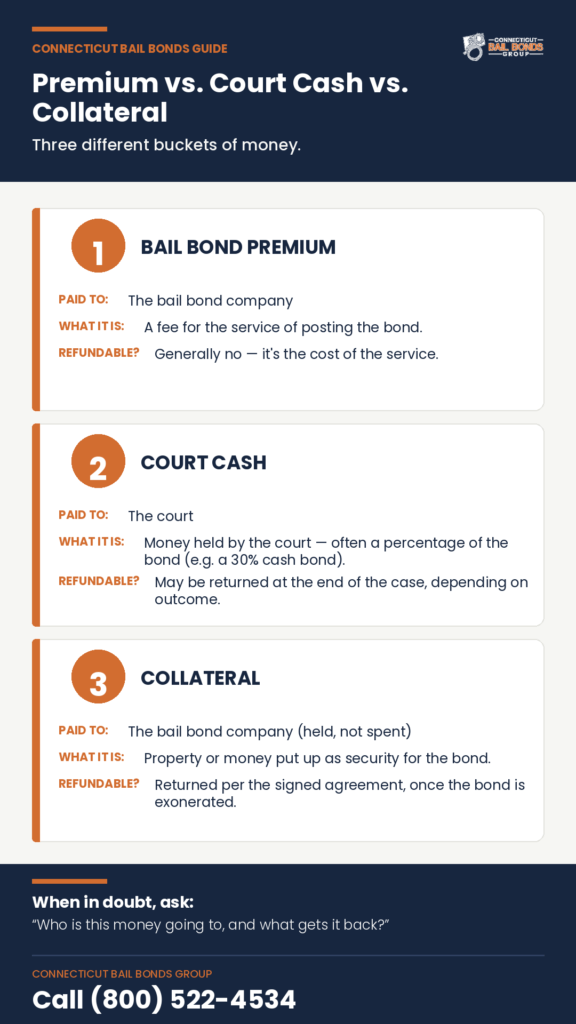
A bail bond premium is paid to the bail bond company.
Court cash is paid to the court.
Collateral may be given to help secure the bond.
These are three different things.
The problem is people use the word “bond” for all of them.
That creates a mess.
One person says, “We paid the bond.”
Another person says, “The bond was raised.”
Another person says, “Get the bond money back.”
Everyone is using the same word.
But they may be talking about different money.
That is how families end up angry at the wrong person.
It’s like five people arguing about dinner, but one person means pizza, one means the bill, and one means the table.
No wonder nobody knows what’s going on.
Can the Bail Bondsman Stop the Judge?
No.
The bail bondsman cannot stop the judge from adding a new condition.
The bail bondsman does not control the prosecutor.
The bail bondsman does not control the court.
The bail bondsman can explain the bond paperwork.
The bail bondsman can explain what was paid.
The bail bondsman can explain the premium and collateral.
But the bail bondsman cannot walk into court and tell the judge what to do.
That is the attorney’s role.
The attorney argues in court.
The judge makes the ruling.
The bail bond company handles the bond.
Each role matters.
But they are not the same role.
Why the Attorney Matters So Much
If the prosecutor asks for a 30 percent cash bond, the defense attorney needs to be ready.
The attorney may argue against the request.
The attorney may explain why the bond is already enough.
The attorney may argue that the 30 percent cash rule does not apply.
The attorney may ask the judge for a lower bond.
There is no promise the judge will agree.
But the argument matters.
In serious gun and drug cases, the next court date can be very important.
Families should not wait until the last minute.
They should speak with the attorney before court.
They should ask what the prosecutor may request.
They should ask what could happen to the current bond.
They should ask if a 30 percent cash bond is possible.
Hard questions are better before court than after court.
After court, the answer may cost more money.
What Should Families Ask Before Posting a Large Bond?
Before posting a large bond, families should slow down.
Yes, that is hard.
Someone you love is in jail.
Everyone wants them out.
The phone is ringing.
The attorney is talking.
The bondsman is talking.
The family group chat is on fire.
Still, you need to ask good questions.
Ask these:
What is the full bond amount?
What is the premium?
Is the premium refundable?
Is collateral needed?
What happens if the prosecutor asks for more bond later?
What happens if the judge adds a cash bond?
What happens if the person misses court?
What happens if the person gets arrested again?
What paperwork am I signing?
Who is responsible if something goes wrong?
These questions do not make you difficult.
They make you smart.
And smart is good when large amounts of money are involved.
What if the Family Cannot Afford the New Cash Requirement?
If the judge adds a 30 percent cash bond and the family cannot afford it, they need to speak with the defense attorney right away.
The attorney may be able to ask the court to review the bond.
The attorney may be able to ask for a change.
The attorney may be able to argue that the cash amount is too high.
But no one should promise what the judge will do.
That is not how court works.
If someone promises you a result, be careful.
Court is not a vending machine.
You do not put in words and get the snack you want.
The judge still decides.
Why Families Get So Confused
Families get confused because bail moves fast.
Most people do not deal with bail every day.
They are scared.
They are tired.
They may not know the law.
They may not know what the attorney means.
They may not know what the bondsman means.
They may not even know what they signed.
That is normal.
But normal does not mean safe.
When the bond is large, the questions need to be large too.
Do not guess.
Do not assume.
Do not take legal advice from someone’s cousin who “knows a guy.”
That guy is usually wrong.
And somehow very loud.
The Main Point
A prosecutor may ask the court to change bond conditions after someone has been released.
A judge may add a 30 percent cash bond in certain cases.
That does not mean the bail bond company did something wrong.
That does not mean the premium is the same as court cash.
That does not mean every gun case is treated the same way.
It means the case is serious and the family needs clear answers.
Final Thoughts
Posting bond is not just about getting someone out today.
It is also about knowing what may happen next.
That is why families need to understand the bond process before paying large amounts of money.
Ask questions.
Read the paperwork.
Talk to the attorney.
Talk to the bail bond company.
Know the difference between premium, collateral, and court cash.
Because when the prosecutor asks for more bond later, confusion gets expensive fast.
And nobody needs expensive confusion.
They already have court.
That is enough.
Disclaimer: This page is for general information only. It is not legal advice. If your loved one is facing a serious criminal charge in Connecticut, speak with a Connecticut criminal defense attorney about the case.
Before posting a large bond in Connecticut, call our office. We can explain the bond process, the premium, the paperwork, and the questions you should ask before making a big money decision.